Planning
Renovation budget: contingency, VAT, advances and the contract (kitchen or bathroom – which costs more?)
How to build a renovation budget that holds: how much to set aside, how to read net and gross quotes, how much to pay up front and what goes in the contract. With a kitchen vs bathroom cost comparison.
Redakcja RemontLab9 min read
On this page
Most rows with a crew do not come from bad faith but from things left unsaid: what the price covers, who buys the materials, when payment is due. Writing it down at the start is dull and saves more nerves than any budget reserve.

Build the budget from stages
In a typical full renovation roughly: bathroom 18%, installations 17%, plaster and painting 17%, floors 15%, kitchen 10%, demolition 8%, joinery 8%, cleaning and extras 7%. For scale, kb.pl puts a full 2026 renovation of a resale flat at 2,800–3,900 PLN/m² and Rankomat priced a full renovation of a 45 m² flat at about 67,000 PLN.
Kitchen or bathroom – which costs more?
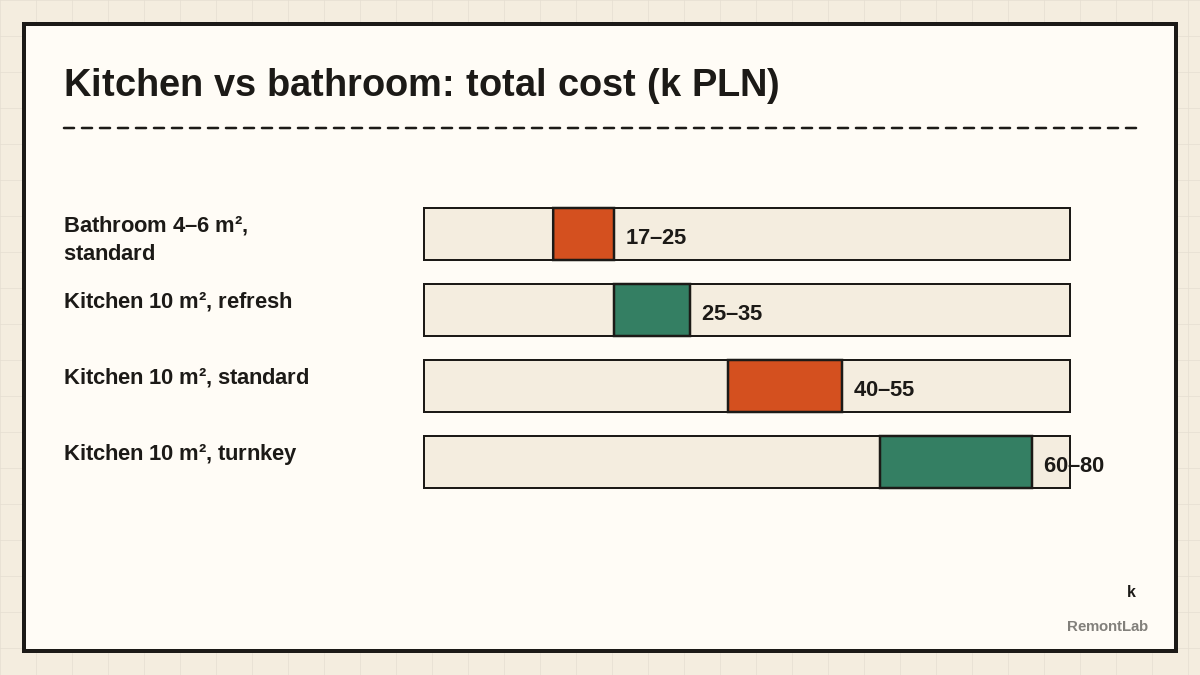
Per muratordom.pl the kitchen costs more in total and the bathroom more per m². A 10 m² mid-range kitchen is about 26,700 PLN in their example; whole-kitchen ranges are 25–35k (refresh), 40–55k (standard) and 60–80k PLN or more (turnkey). A 4–6 m² bathroom is 17–25k PLN. In a 45 m² flat the kitchen can take up to 40% of the budget.
Contingency and VAT
Experts recommend 10–15% extra; 15–20% in old buildings. Without a written estimate overruns of 20–40% are common. Residential renovation usually carries 8% VAT, but always ask which rate applies and whether a quote is net or gross.

Contract and payments
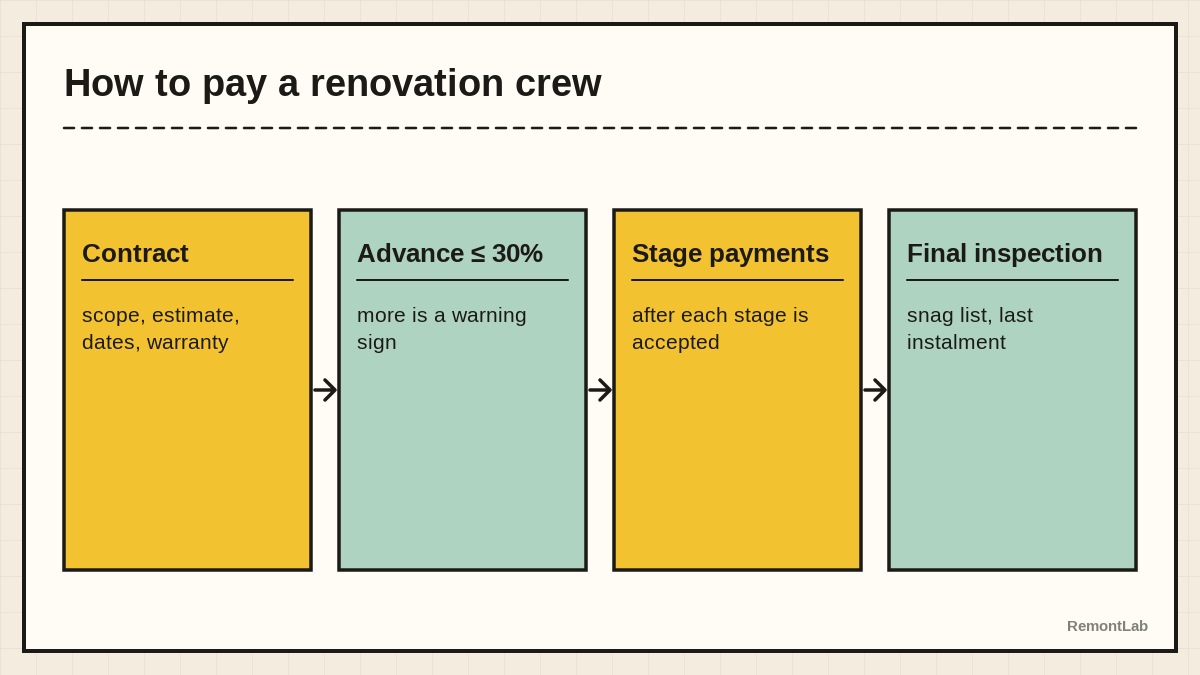
Include the exact scope and itemised estimate, stage dates, who buys materials, the warranty (usually at least 2 years) and a payment schedule. An advance above 30% is a warning sign. A safe pattern: up to 30% up front, instalments after accepted stages, the last payment after snags are fixed.
Start with the renovation cost calculator, then split the stages with the bathroom and kitchen calculators and the renovation planner.
What a contract with the crew should contain
- Parties' details and the address of the flat where the work is done.
- Scope – a list of items with quantities and material standard; the more precise, the fewer disputes.
- Start and end dates and a schedule of stages.
- Price and payment terms – staged payments tied to acceptance; a small advance.
- Who buys materials and who is responsible for quantities.
- Contractual penalties for delay and a defect-reporting procedure.
- Guarantee and statutory warranty on the work done.
- The contractor's liability insurance – ask whether they have it.
- Access to the flat and cleaning after the work.
Staged payments – a sample split
| Stage | Share of price | Condition of payment |
|---|---|---|
| Advance at start | up to about 10–20% | Contract signed and crew on site |
| Installations and plaster | about 25% | Acceptance with installation test results |
| Screed, skim coats, tiles | about 30% | Stage acceptance, photos of waterproofing |
| Floors and painting | about 25% | Acceptance of finishes |
| Completion and fixes | last 10% | Final protocol with no remarks |
This is our own example; adapt terms to the size of the job. A final instalment held until defects are fixed is the best motivation for corrections.
VAT in practice – 8% or 23%
For renovating a dwelling a building or renovation service usually carries the reduced 8% rate, while materials you buy yourself carry 23%. Crews invoice differently: some include materials in a lump sum at 8%, others issue separate invoices. Before signing, agree what the price covers and whether it is net or gross. If in doubt, ask an accountant.
Planning the reserve
Most sources advise 10–20% of the budget for the unforeseen; in older flats and when changing installations 15–20% is better. The reserve is not for “upgrades” but for what appears once walls and floors are opened: corroded pipes, uneven screed, damp. If some is left – good; if it runs out, adjust the finishing scope rather than the installations.
Red flags when choosing a crew
- A large advance (over 30%) or the whole sum up front.
- No written contract or estimate.
- A price much lower than the rest with no explanation (for example waterproofing omitted).
- No references or photos of previous jobs.
- Reluctance to put a schedule and guarantee in writing.
Lay out the budget in the renovation cost calculator and add the reserve; build the schedule in the renovation planner.
How others write about budgets
| Site | What it says | Note |
|---|---|---|
| muratordom.pl | Kitchen versus bathroom renovation: what costs more in 2026; the reserve | Split into stages |
| Rankomat | Flat renovation 2026: at least 67k PLN for a tradesperson, about a third of spending | Survey data, not a price list |
| pewnylokal.pl | Stages of settling with the crew: how to set a schedule so you do not lose money | Staged payments |
Checklist before signing the contract
- Scope with quantities and material standard.
- Deadline, schedule and penalties for delay.
- Staged payments, small advance.
- Who buys materials and who is responsible for quantities.
- Guarantee and warranty on the work.
- The contractor's liability insurance.
- The defect-reporting and acceptance procedure.
Frequently asked questions
How much contingency should I keep?
10–15%, and 15–20% in old buildings.
How big should the advance be?
Small – usually up to 10–20%; over 30% is a warning sign. Pay the rest in stages after acceptance.
Do I need a written contract with the crew?
Yes. A written contract with scope, deadline, payments and guarantee protects both sides.
Sources and real examples
The figures in this guide come from the pages below (accessed at publication). Prices change – check current quotes.
Redakcja RemontLab
The desk collects prices, checks formulas and cites every number.
Did you like this guide?
Get the next ones once a month.