Planning
Renovating a flat in a block: when co-op or owners' community consent is needed and when notification is enough
Painting and replacing windows usually need no formalities, but risers, ventilation and load-bearing walls do. We combine the rules from several guides and the questions to ask the manager before the first chisel. This is not legal advice.
Redakcja RemontLab8 min read
On this page
This is not legal advice. Rules depend on your co-op's or community's own regulations and the building's legal status. Below is what the guides (muratordom.pl, kb.pl) say; ask your manager first and, for structural changes, a licensed designer.
In a block you do not renovate in a vacuum: neighbours sit behind the wall and the walls hold risers that are not yours. So the first question is not “where to start” but “am I touching anything shared”.

Four questions in order
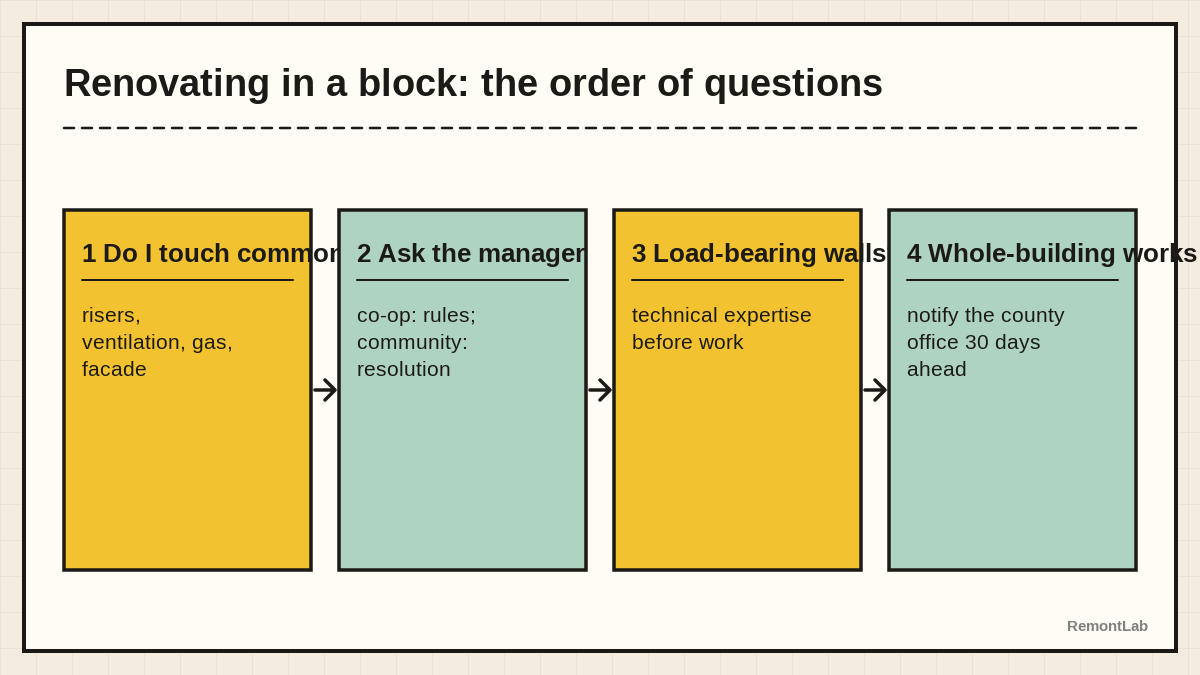
1) Do I touch common parts (risers, ventilation, gas, facade)? 2) Ask the manager: co-op rules or community resolution. 3) Is it a load-bearing wall? A technical expertise is needed first, a building permit for structural changes. 4) Do the works cover the whole building? Those are notified to the county office 30 days ahead.
Usually no formalities
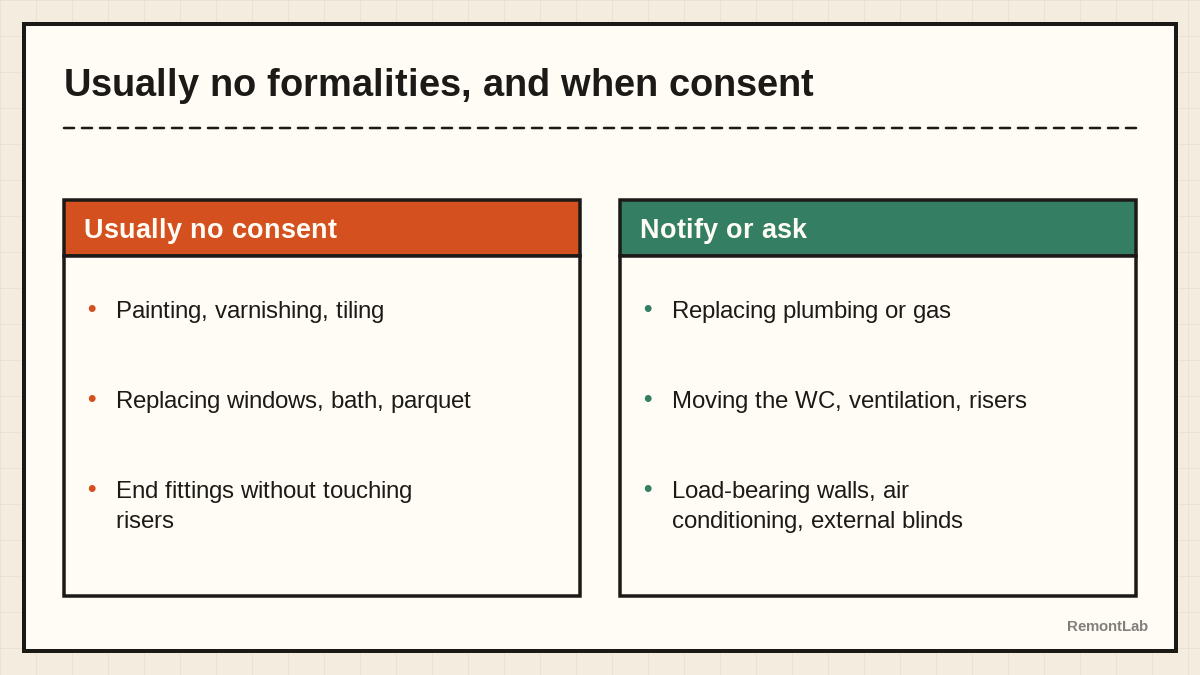
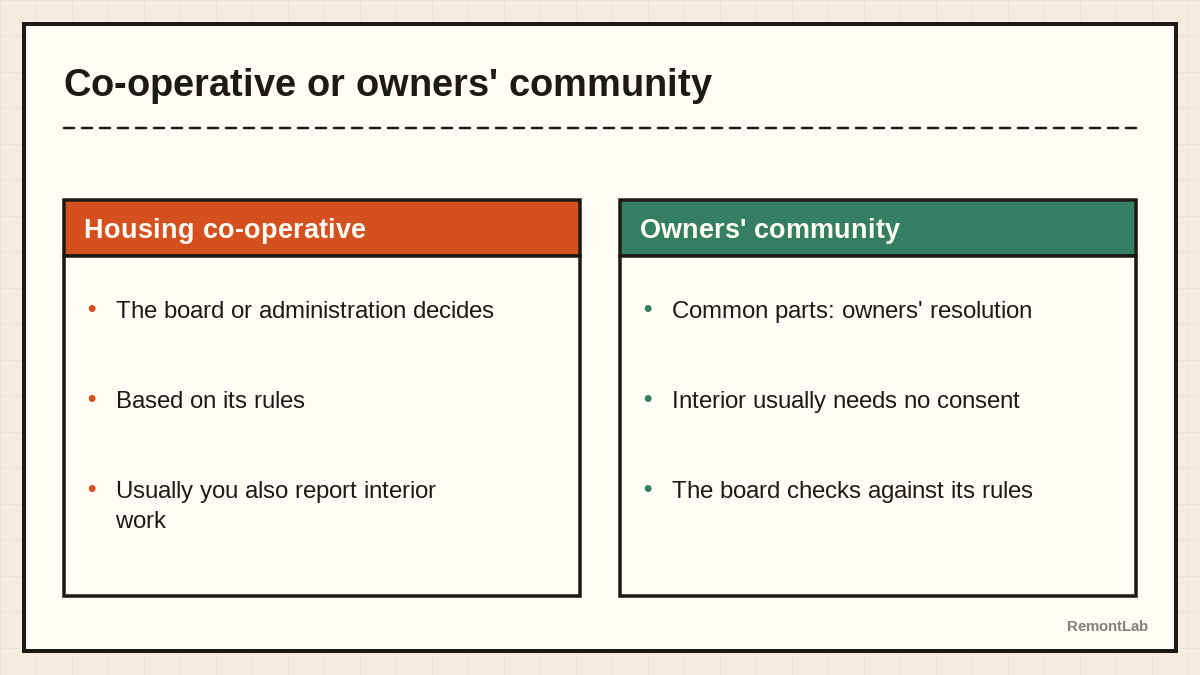
muratordom.pl lists painting, varnishing, replacing windows, tiles, floors, baths and end fittings as not needing formalities if risers are not touched. In co-ops, interior renovation is usually reported anyway.
Notify or ask
Replacing plumbing or gas risers, moving the WC, ventilation, load-bearing walls, air conditioners and external blinds. Swapping a radiator like for like needs a written request to the administrator but no building permit.
Penalties
kb.pl describes orders to restore the previous state and liability for damage; we found no single fine amount in the sources and do not quote one. An insurer may refuse a claim after unreported work on installations.
Add time for approvals to your plan in the renovation planner.
A reminder: this is a summary of guides, not legal advice. The rules depend on your co-op's or community's regulations and the building's legal status.
A template letter to the manager
A written question protects you more than a chat in the stairwell. A structure you can follow (not a legal template):
- Details: your name, the flat's address, land-register or flat number.
- Scope of work: describe it briefly (for example “replacing the wiring inside the flat, no changes to the risers”, “replacing windows with PVC in the same colour”).
- Dates and working hours and the contractor's details.
- Questions: whether the work needs consent or notification, on what terms, whether there are renovation rules.
- A request for a written reply within a reasonable time (for example 14 days).
Windows, air conditioning and blinds – the facade is watched
The facade is a common part of the building and its look is often protected by the rules. According to the sources we compared, air conditioners, aerials and external blinds usually need consent from the community or co-op, though details depend on the law and the rules (muratordom.pl covers external blinds in blocks in a separate article). Replacing windows in your own flat usually needs no building permit, but some communities require a uniform frame colour and glazing pattern. Always ask before ordering windows or an air conditioner.
Risers, ventilation, gas – why the caution
kb.pl and muratordom.pl agree that work on shared installations (water and sewer risers, ventilation, gas) must be reported to the administration or co-op. The practical reason: an error in one flat can flood, smoke out or endanger the whole building. In a flood an insurer can refuse a claim if the damage came from unreported work on an installation (kb.pl).
Partition and load-bearing walls
Per muratordom.pl work inside a flat that does not touch common parts generally needs no community consent – this includes changing the layout of partition walls. Load-bearing walls are different: touching them needs a technical expertise beforehand, and for structural changes a building permit. If you do not know whether a wall is load-bearing, ask a structural engineer or the administrator; in panel blocks almost all room walls can be load-bearing.
Neighbours, noise and working hours
Beyond formal consents, good neighbourliness counts: tell neighbours the dates and noisy stages, leave a phone number for yourself or the crew leader, protect the stairwell and lift, clear rubble. Community rules usually set working hours (for example weekdays in the daytime). Neighbours' complaints can lead to the administrator stopping the work.
What unauthorised work risks
kb.pl describes cases where unreported work led to an order to restore the previous state and liability for damage. We found no single fine amount in the sources and do not quote one; it depends on the law and the case. So the practical advice: ask before starting, document the answers and keep before-and-after photos.
Add time for approvals to your plan in the renovation planner.
What other sites write about it
| Site | What it says | Note |
|---|---|---|
| muratordom.pl | No formalities for painting, tiles, windows; whole-building works are notified to the county 30 days ahead; load-bearing walls – expertise and permit | In a co-op usually even interior work is reported |
| kb.pl | Unauthorised renovation; limits: load-bearing walls, installations, facade, noise; risers and ventilation to be reported | Interior – per the rules |
| muratordom.pl – radiator | Swapping a radiator like for like: a written request to the administrator, no building permit | A mistake = a flood and liability |
Checklist before renovating in a block
- Ask the administration in writing about consents and the rules.
- Agree working hours and a place for rubble.
- Find out which walls are load-bearing.
- Report work on risers and ventilation.
- Inform your neighbours.
- Keep the replies and before/after photos.
Frequently asked questions
Do I need consent to renovate a flat in a block?
It depends on scope: painting and tiling usually not, work on risers, ventilation, gas and load-bearing walls yes. In a co-op you usually report interior work too – check the rules.
Must I always report a flat renovation in a co-op?
Often yes – it depends on the rules. Ask the administration before starting and request a written reply.
Can I fit an air conditioner in a block?
Usually the community's or co-op's consent is needed, because an outdoor unit changes the facade. Check the rules before buying.
Sources and real examples
The figures in this guide come from the pages below (accessed at publication). Prices change – check current quotes.
Redakcja RemontLab
The desk collects prices, checks formulas and cites every number.
Did you like this guide?
Get the next ones once a month.