Materials and quantities
Vinyl or laminate flooring in 2026? How to choose (with the cost of 20 m²)
Vinyl wins where there is water or underfloor heating; laminate wins in dry rooms on a tight budget. We compare prices, durability and fitting and add up the full cost of 20 m².
Redakcja RemontLab8 min read
On this page
Vinyl and laminate look alike in the shop and behave differently at home: one likes water and underfloor heating, the other is cheaper and warmer underfoot. Here is how to choose without guessing, on real numbers.
The verdict
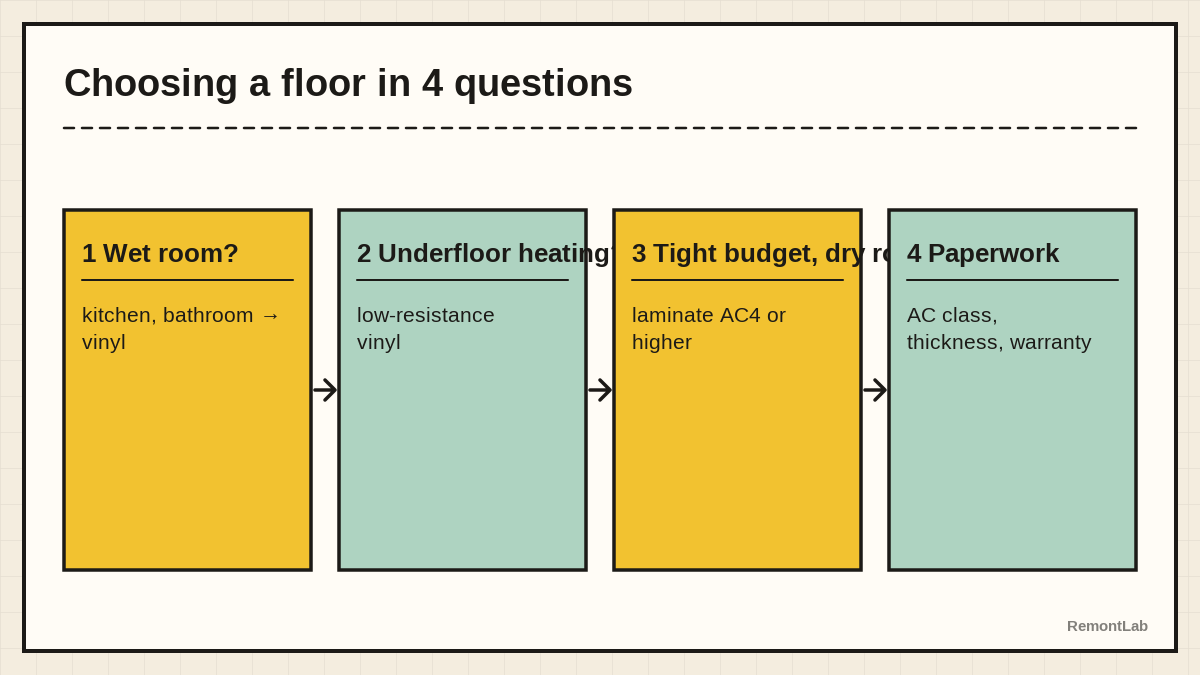
- Kitchen, bathroom, hallway, underfloor heating: vinyl.
- Bedroom, living room, study – dry and on a budget: laminate AC4 or AC5.
- Uneven subfloor: laminate forgives more; vinyl telegraphs every bump.
2026 prices
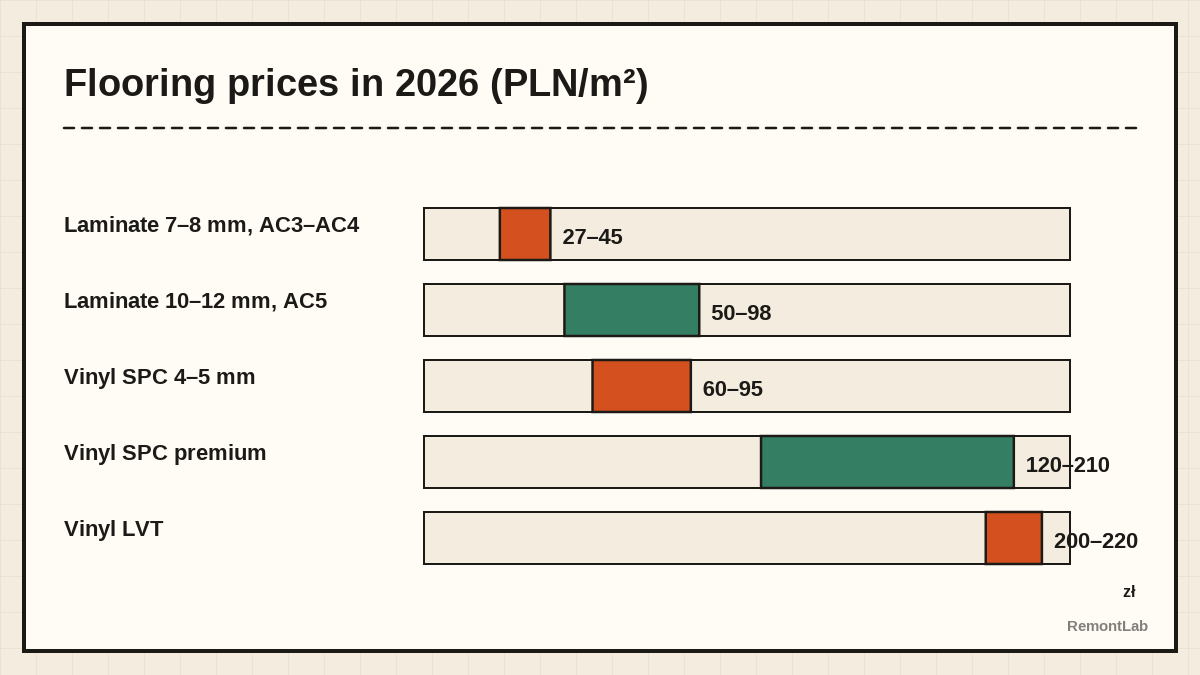
Laminate 7–8 mm AC3–AC4 costs 27–45 PLN/m², 10–12 mm AC5 50–98 PLN/m². SPC vinyl 4–5 mm is 60–95 PLN/m², premium rigid-core 120–210 PLN/m² and LVT 200–220 PLN/m². Add 5–10% for cuts.
Criterion by criterion
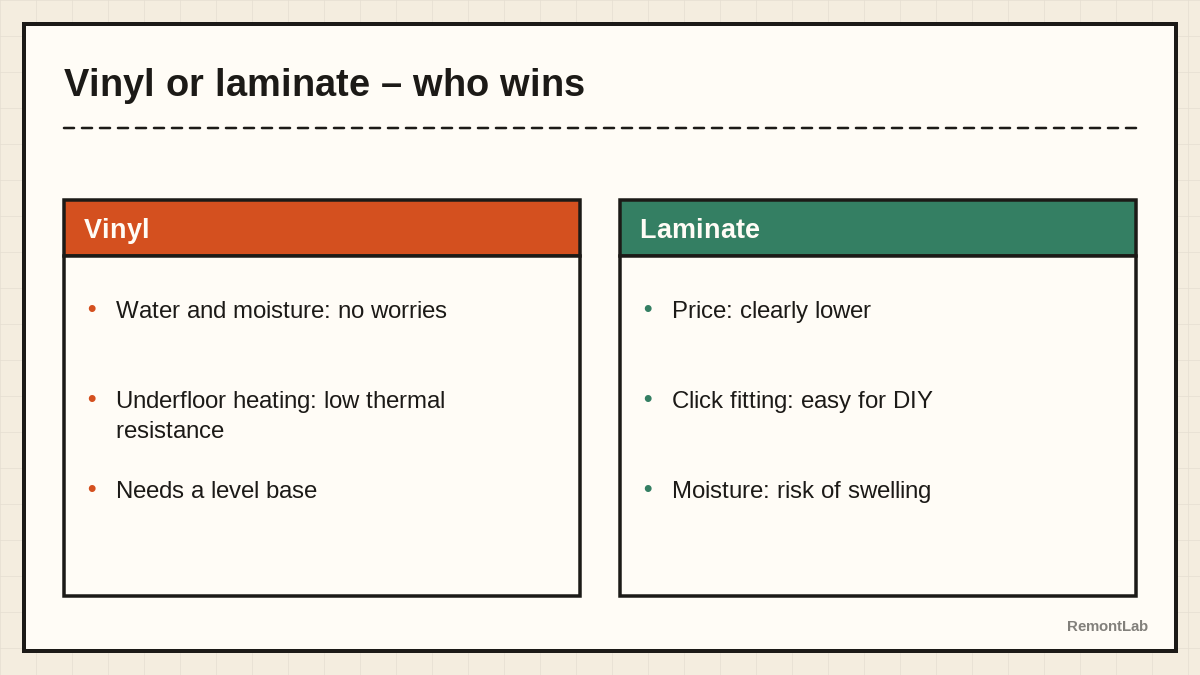
- Moisture: vinyl shrugs off water; cheaper laminate swells.
- Underfloor heating: vinyl has very low thermal resistance and suits it well; check each product's approval.
- Durability: vinyl resists scratches better; damaged laminate planks are replaced one by one.
- Fitting: click laminate is DIY-friendly; vinyl needs a level base, often self-levelling screed.
What 20 m² really costs
Adding fitting at about 75–85 PLN/m²: laminate AC3–AC4 comes to about 2,000–2,600 PLN, AC5 2,500–3,700, basic SPC vinyl 2,700–3,600 and premium vinyl 3,900–5,900 PLN. The gap between good laminate and basic vinyl is often a few hundred zloty.
Count packs, underlay and skirting with the flooring calculator.
Reading the specs: AC, wear layer and thickness
With laminate the key is the abrasion class AC (AC3 – bedrooms, AC4 – living rooms and children's rooms, AC5 – heavily used rooms). With vinyl what counts is the wear-layer thickness (0.3–0.55 mm) and the use class (23 – domestic, 33 – commercial). The overall thickness (4–8 mm) affects comfort and tolerance of an uneven substrate, though thicker is not always better. The core matters too: SPC (stone composite) vinyl is stiffer and less sensitive to temperature, while flexible glued vinyl (LVT) is softer and quieter underfoot.
Fitting method and labour cost
Both come as floating (click) – not glued to the substrate, laid on underlay; quicker and cheaper but the substrate must be level. And glued (mostly vinyl) – gives a quieter, more stable floor and works better with underfloor heating, but needs a perfect substrate and costs more. Per cenauslug.pl labour is about 33–48 PLN/m² for click vinyl and 53–74 PLN/m² for glued (floating laminate 29–42 PLN/m²).
Which where
| Room | Choice | Why |
|---|---|---|
| Living room, bedroom | Laminate AC4/AC5 or vinyl | Warm to the touch, cheaper; vinyl quieter |
| Kitchen | Vinyl | Resists water and stains |
| Bathroom | Vinyl in the dry zone, porcelain in the wet one | Vinyl tolerates humidity but not standing water under joints |
| Hallway | Vinyl or AC5 laminate | High abrasion and dirt resistance |
| Room with underfloor heating | Vinyl (low thermal resistance) | Conducts heat well; check the manufacturer's approval |
Noise and comfort
Floating laminate can be loud underfoot if the underlay is thin. A good underlay and proper floating fixing soften this. Vinyl, especially glued or with a built-in underlay, is quieter and warmer to the touch. In a block with noise-sensitive neighbours choose a sound-deadening underlay and check the impact-noise reduction rating.
Purchase mistakes
- Choosing by looks without checking the use class.
- No acclimatisation (at least 48 hours) and no expansion gap at walls.
- Fitting on an uneven substrate – the floor flexes and creaks.
- A floating floor under heavy furniture and a kitchen island – blocks the floor's movement.
- Foam underlay on underfloor heating.
Count packs in the flooring calculator; if you are torn between vinyl and parquet, see our parquet guide.
What other comparisons show
| Site | What it says | Note |
|---|---|---|
| muratordom.pl | 2026 panel prices; vinyl and laminate on underfloor heating (vinyl thinner, low thermal resistance) | Check the underfloor-heating approval |
| kb.pl | A comparison of popular laminate and vinyl panels | Gives few numbers |
| cenauslug.pl | Click vinyl 33–48 PLN/m², glued 53–74; laminate 29–42 (labour) | Prices depend on region |
Checklist when choosing panels
- Check the abrasion class (AC) or wear layer.
- Choose the fitting method: floating or glued.
- Ask about approval for underfloor heating.
- Check the substrate's level.
- Buy an underlay suitable for the panel type.
- Add skirting and threshold profiles.
Three things to get from the shop in writing
Before you pay, ask the seller for the underfloor-heating approval of the exact product, the wear-layer thickness (vinyl) or AC class (laminate), and the largest area allowed without an expansion joint. Many complaints come from floating floors that expand and lift in a big open-plan room because nobody read that last number in the data sheet. Ask too whether a damaged plank can be replaced on its own or whether a whole row must be lifted, and keep the receipt together with the batch number: a colour from a later batch can differ from the first one.
Frequently asked questions
Is vinyl suitable for underfloor heating?
Yes – it has low thermal resistance. Check the product's approval and maximum floor temperature.
Is vinyl waterproof?
The material is, but standing water under the joints can harm the substrate. It is safer than laminate in kitchens and bathrooms.
What AC class laminate for a living room?
AC4, and AC5 with heavy use or pets.
Sources and real examples
The figures in this guide come from the pages below (accessed at publication). Prices change – check current quotes.
Redakcja RemontLab
The desk collects prices, checks formulas and cites every number.
Did you like this guide?
Get the next ones once a month.