Materials and quantities
How much paint for 50 m²? Quick formula and examples
For 50 m² of walls and two coats you need roughly 9–10 litres of paint. Here is the formula, a room example and the mistakes that inflate your shopping list.
Redakcja RemontLab6 min read
On this page
A scene from every DIY shop: you stand at the paint shelf with “50 m²” in your head and cannot tell whether to take one tin or five. That number usually means the floor, not the walls, and that is where the trouble starts. Let us break it into simple steps.
The formula
Litres = area × coats ÷ coverage (m²/l), then add 10% reserve.
For 50 m²: 50 × 2 ÷ 12 = 8.3 l, or 9.2 l with the reserve. The nearest pack is a 10 l tub.

Example: a 4.5 × 3.5 m room, 2.6 m high
- Perimeter 2 × (4.5 + 3.5) = 16 m, walls 16 × 2.6 = 41.6 m²
- Subtract a door (about 1.85 m²) and a window (about 1.5 m²): 38.3 m²
- Two coats at 12 m²/l: 38.3 × 2 ÷ 12 = 6.4 l
- With a 10% reserve: about 7 l
What increases paint use?
- Fresh plaster or skim coat absorbs more – prime first.
- Going from a dark to a light colour often needs a third coat.
- Rough surfaces can drop coverage to 8–10 m²/l.
- Spraying uses noticeably more than rolling.
Use the paint calculator for your exact room – it handles doors, windows, the ceiling and suggests can sizes.
Real examples: how much coverage varies
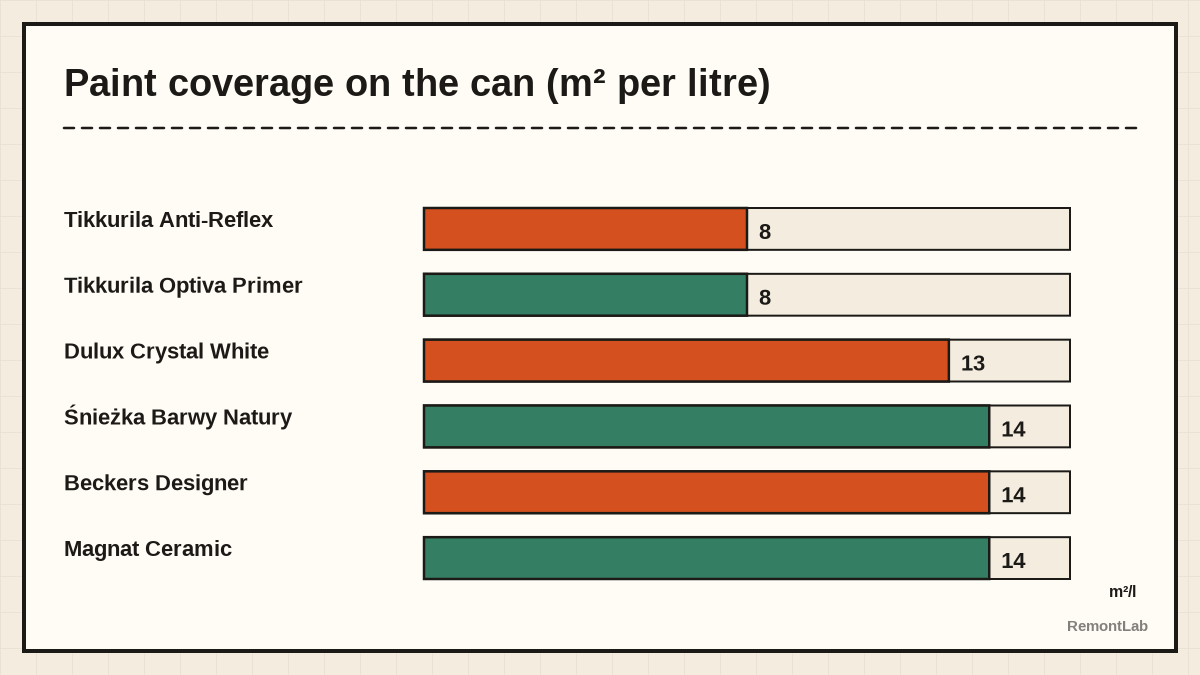
The kb.pl comparison shows declared coverage of popular paints at 12–14 m²/l (Śnieżka, Luxens, Beckers and Magnat 14, Dulux Crystal White 13), while specialty paints such as Tikkurila Anti-Reflex and Optiva Primer give about 8 m²/l. Most need two coats; Beckers Designer White needs three. Check the number of coats, not just coverage.
“50 m²” – walls or floor? The biggest trap
The commonest mistake is confusing a flat's size with the area to paint. A 50 m² flat is 50 m² of floor. Walls and ceilings add up to several times that: kb.pl points out that the paint needed for 50, 70 and 100 m² flats differs more than the floor area suggests, and cenauslug.pl estimates about 130–140 m² of walls and ceilings in a 50 m² flat. So “how much paint for 50 m² of walls” and “how much paint for a 50 m² flat” have very different answers.
| Question | Area to paint | Paint for 2 coats (12–14 m²/l) |
|---|---|---|
| 50 m² of walls only | 50 m² | about 7–8.5 l |
| A 50 m² flat (walls + ceilings, about 130–140 m²) | about 135 m² | about 19–23 l |
| One room 4.5 × 3.5 m (walls + ceiling) | about 56 m² | about 8–9.5 l |
The table is our own arithmetic on the typical coverage of 12–14 m²/l per coat (the range kb.pl gives for emulsion paints). Measure your rooms and use the calculator; floor area alone is not enough.
When the tin's coverage is unrealistic
The manufacturer states coverage for one coat on a smooth, primed, light surface. In practice:
- Fresh gypsum plaster without primer soaks up paint – real coverage can fall to 8–9 m²/l (a figure from a source we found in search results; read it as a warning, not a norm).
- Going from dark to light needs an extra coat; with strong contrast consumption can rise by up to half.
- Texture (textured plaster, paintable wallpaper) uses 20–40% more paint than a smooth wall.
- A short-pile roller on a rough wall misses the dips – use a longer pile rather than pressing harder.
Buy with a 10% reserve, and take tinted paint in one go from one batch – a shade bought later can differ slightly.
Step by step, with openings subtracted
- Perimeter × height. A 4 × 5 m room, 2.6 m high: perimeter 18 m, walls 18 × 2.6 = 46.8 m².
- Subtract openings. Two windows of 1.5 m² and a door of 1.9 m² = 4.9 m² → 41.9 m². Skip openings smaller than 1 m².
- Add the ceiling if you paint it. 4 × 5 = 20 m² → 61.9 m² in total.
- Multiply by the coats. Two coats = 123.8 m².
- Divide by coverage. 123.8 ÷ 12 = 10.3 l (at 14 m²/l: 8.8 l).
- Add 10% reserve → 9.7–11.3 l: a 10 l tin plus 2.5 l for touch-ups.
This is our own calculation from manufacturers' stated coverage, not a measurement of a specific tin. Always check the data sheet.
Primer, tape and the rest of the shopping list
Paint is not the only cost. cenauslug.pl's material list for a 50 m² flat includes primer, masking tape, sheeting, rollers and brushes – the items that are easy to forget in a budget. Typically you need:
- deep-penetration or paint primer – about 1 l per 8–10 m² (check the data sheet),
- masking tape for edges, sheeting for floor and furniture,
- an 18–25 cm roller (a proper one, not foam), an angled brush for corners, a tray with a grid,
- filler for small defects and 120–180 grit sandpaper.
A sensible painting sequence
Fill and sand → dust off and wipe → prime (dries 2–4 hours) → first coat → second coat after the time on the tin (usually 2–4 hours) → remove the tape before the paint is fully dry. Paint the ceiling before the walls, from the window towards the door, and cut in corners with a brush before rolling. Washing a painted wall is possible only after full curing, usually about 28 days.
What 50 m² of paint costs – an example
At the prices in our guide to paint types (acrylic 70–100 PLN, latex 150–220, ceramic 300–420 per 10 l), 9–10 l for 50 m² of walls means material from about 70 to about 420 PLN – the type of paint matters more for cost than the quantity. Add primer (tens of zloty) and small items.
How other sites count it
| Site | What it says | Watch out for |
|---|---|---|
| kb.pl | Emulsion paint coverage 12–14 m²/l; paint needed for 50, 70 and 100 m² flats differs more than the floor area suggests | Tin coverage is for one coat |
| cenauslug.pl | A 50 m² flat has about 130–140 m² to paint; its estimate includes primer, tape, sheeting and rollers | Figures are for the whole flat, not just the walls |
| muratordom.pl | A guide to the amount of paint before painting; coverage depends on the substrate's absorbency | Check the specific paint's data sheet |
Checklist before buying paint
- Measure rooms (height × perimeter) instead of using floor area.
- Subtract large openings (windows, doors) but not small ones.
- Check coverage and the number of coats on the tin.
- Add primer, tape, sheeting and rollers.
- Add 10% reserve and buy from one batch.
- Test the colour on the wall.
Frequently asked questions
How many litres for 50 m² of walls?
With two coats at 12 m²/l about 8.3 litres, so 9–10 litres including a reserve.
Do I need to prime first?
Yes, especially after plastering or skimming. Primer evens out absorption and reduces paint use.
How much paint for 50 m² of walls, two coats?
At 12–14 m²/l about 7–8.5 litres, plus 10% reserve – in practice a 10-litre tin.
How much paint for a 50 m² flat?
The flat's size is floor area. Walls and ceilings are usually 130–140 m², about 19–23 litres for two coats.
Do I need to prime before painting?
Yes, especially after filling and on gypsum plaster. Without primer paint is used up faster and patches show.
Sources and real examples
The figures in this guide come from the pages below (accessed at publication). Prices change – check current quotes.
Redakcja RemontLab
The desk collects prices, checks formulas and cites every number.
Did you like this guide?
Get the next ones once a month.