Materials and quantities
EPS or mineral wool for the facade? What insulating a house really costs in 2026
Three sites, three different prices per square metre. We explain the gaps, how polystyrene and wool differ, and what a 10 × 8 m house costs.
Redakcja RemontLab3 min read
On this page
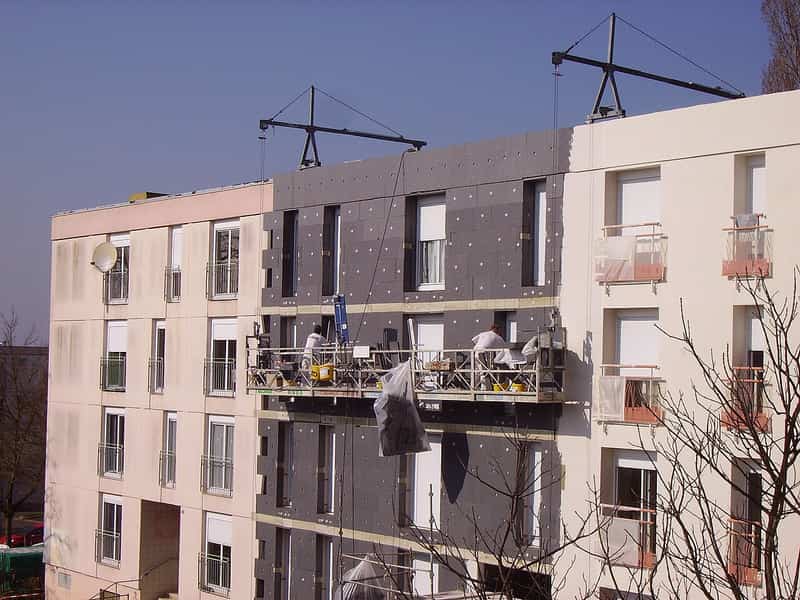
Ask three contractors about insulating a facade and you will get three different figures. Nobody is necessarily cheating you: one counts only the boards, another labour with adhesive and mesh, the third a whole package with scaffolding and render. Before comparing quotes, find out what each of them actually covers.
Where the different prices come from
In the results we reviewed: kb.pl puts labour at 115–120 PLN/m² net and a full set of materials with 15 cm EPS at 160–180 PLN/m². Globenergia counts everything and reaches 220–340 PLN/m² for EPS and 300–450 PLN/m² for wool. pewnylokal prices 12–15 cm EPS at 195–250 and 15 cm wool at 236–300.
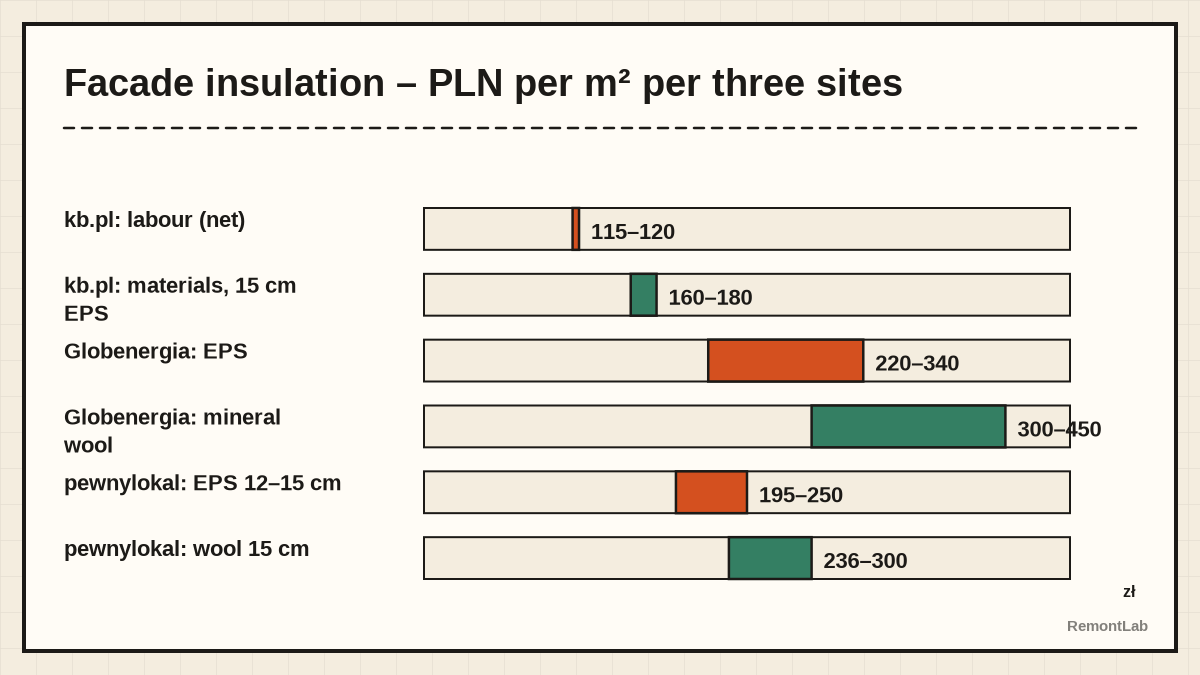
Add kb.pl's labour and material (275–300 PLN) and you land in the middle of Globenergia's range. So the realistic turnkey cost is several hundred zloty per metre, not just over a hundred. Then come items that are easy to forget: scaffolding, render (for wool 40–65 PLN/m² on average) and external sills (45–80 PLN per running metre).
EPS and wool – what really differs
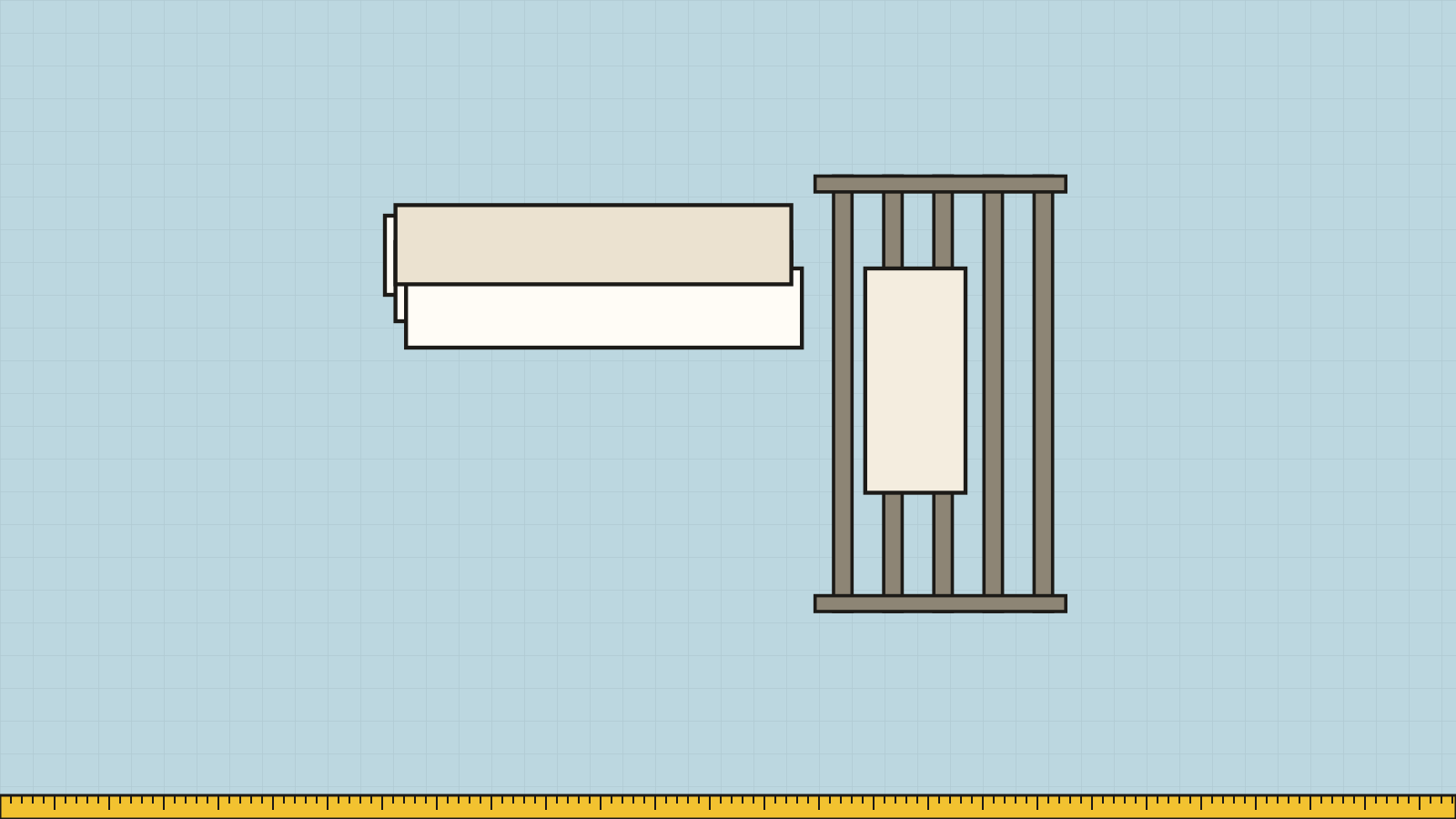
EPS is lighter, easier to cut and usually cheaper. Mineral wool costs more but damps outside noise better, which matters on a busy street. You also pay for it in fitting: it is heavier, so usually needs fixings as well as adhesive, and it must not get wet before it is rendered.
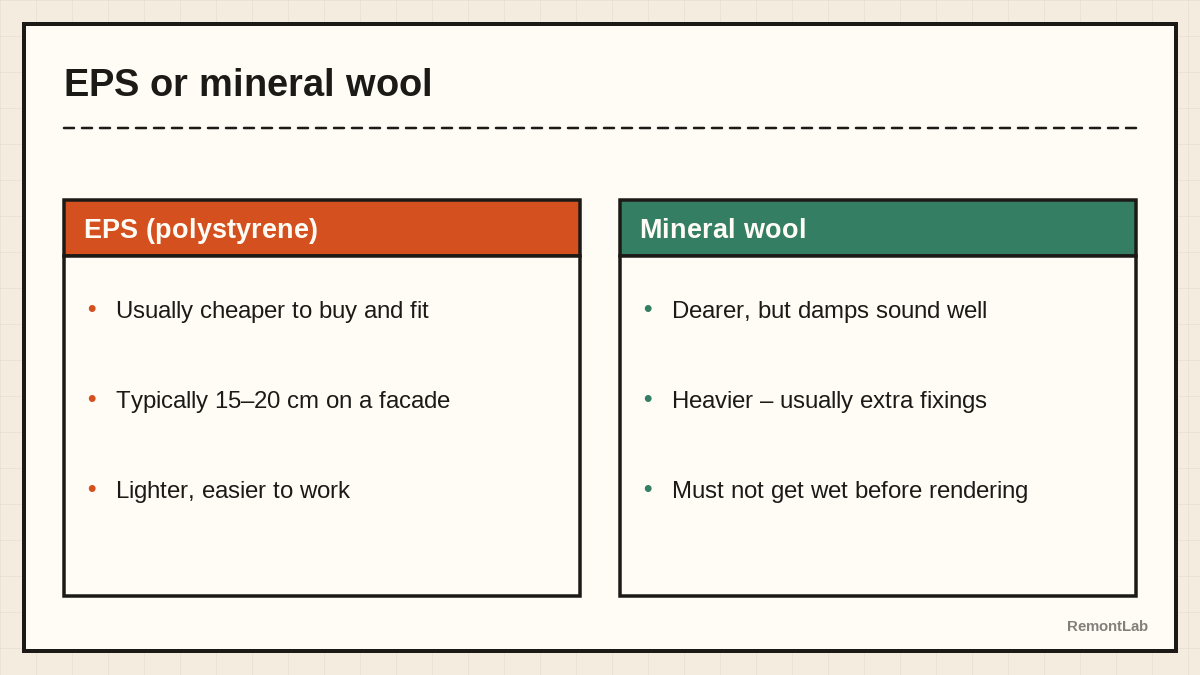
Thickness? On a family house 15–20 cm is the usual pick, though the design and thermal requirements decide, not habit.
Example: a 10 × 8 m house
The perimeter is 36 m; at 2.6 m high that is 93.6 m². Subtract windows and doors (say 14 m²) and about 80 m² remain. On Globenergia's ranges that is 17.6–27.2k PLN with EPS and 24–36k with wool. Our own arithmetic – use it as a starting point for talking to a contractor.
Thermal bridges – where most things go wrong
cenauslug.pl rightly stresses that what decides performance is not thickness alone but care at the details: window reveals, plinth, balconies, parapets. 15 cm laid well can beat 20 cm laid carelessly.
Insulating from the inside?
In a block flat it is tempting to insulate a cold wall from inside. Be careful: moisture condenses on the cold side of the wall, where you cannot see it, which leads to damp and mould. You also lose floor area and the thermal bridges stay. A vapour barrier and a proper design are needed (general building knowledge, not a conclusion of one cited source).
Estimate the material in the wall insulation calculator before you collect quotes.
Frequently asked questions
Is mineral wool better than EPS?
It damps sound better but costs more and is heavier. For insulation alone, thickness and workmanship matter more than the material's name.
Sources and real examples
The figures in this guide come from the pages below (accessed at publication). Prices change – check current quotes.
Redakcja RemontLab
The desk collects prices, checks formulas and cites every number.
Did you like this guide?
Get the next ones once a month.