Materials and quantities
How much concrete for footings and a slab? Cement, sand, gravel
A 36 m footing of 50×40 cm needs about 7.6 m³ of concrete. Here is how to work out volume and the cement, sand and gravel to buy.
Redakcja RemontLab5 min read
On this page
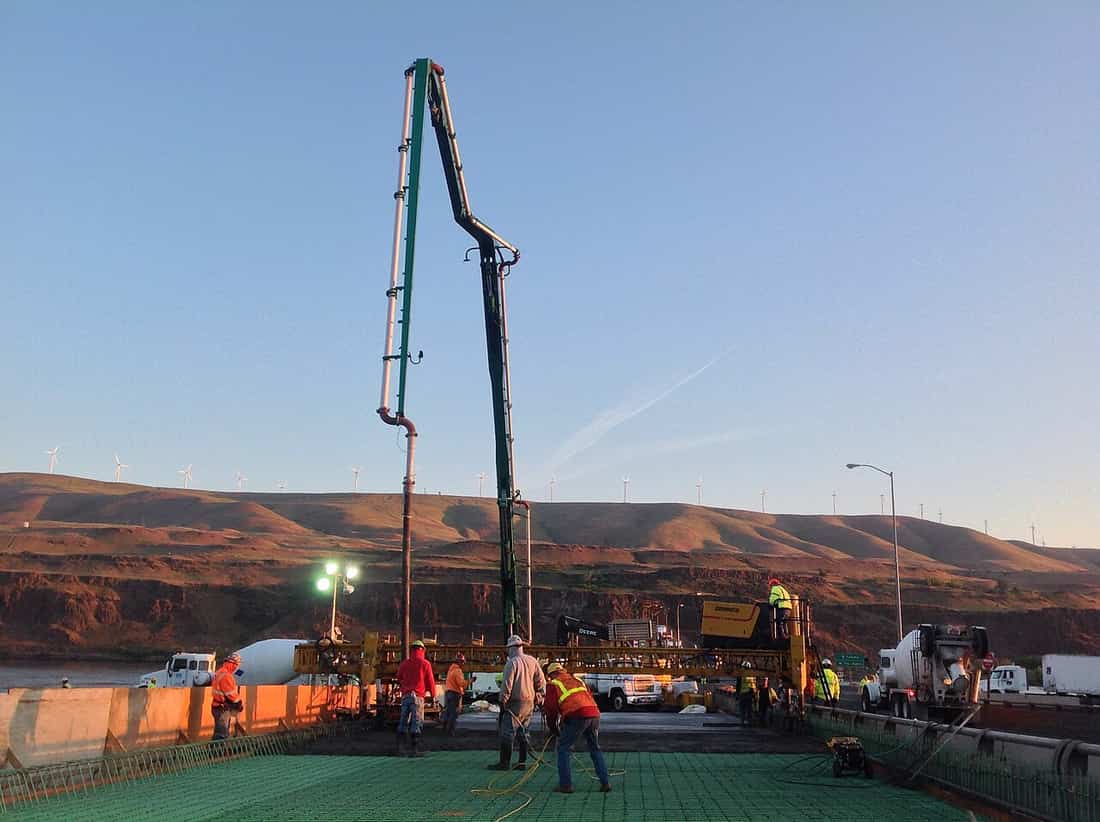
Ready-mix concrete is ordered once, and you cannot “top it up in an hour”, because what has already set will not bond with the new load as it should. So work out the volume calmly, with a margin, before you phone the plant.
Volume
- Slab: length × width × thickness
- Footing: total length × width × height
- Round column: π × (diameter ÷ 2)² × height
Add about 5% reserve for uneven trenches and losses.

Example: strip footings
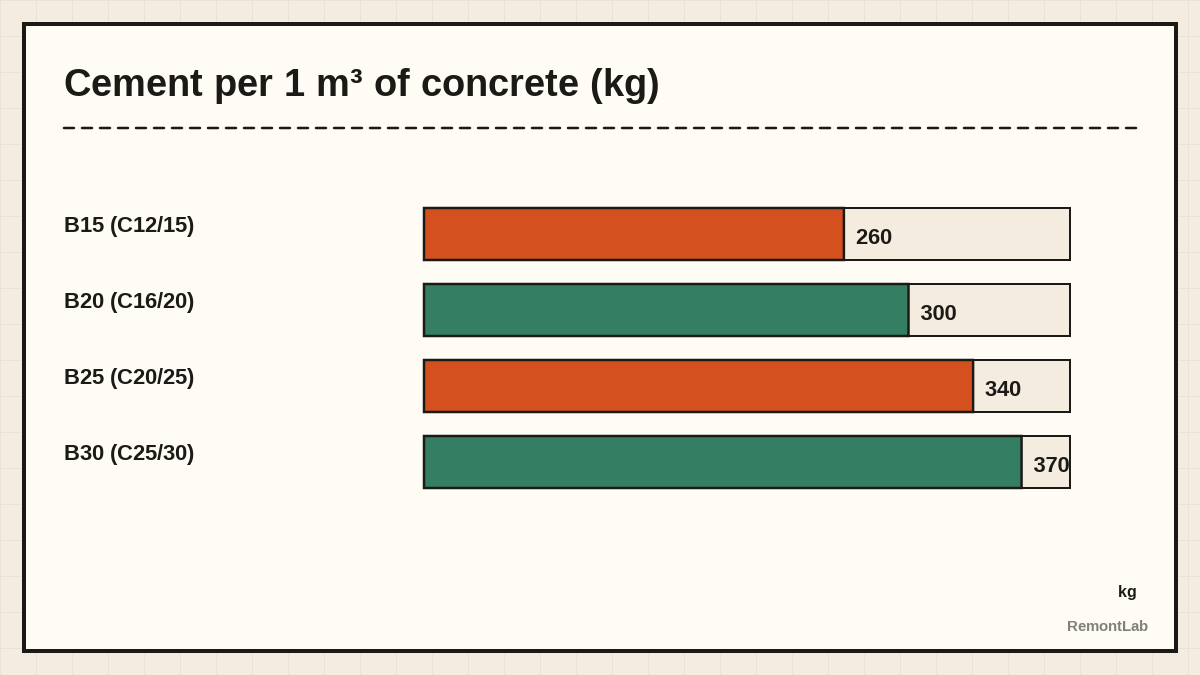
36 m long, 50 cm wide, 40 cm high: 36 × 0.5 × 0.4 = 7.2 m³, or 7.56 m³ with reserve. For B20 (300 kg cement per m³) that is 2,268 kg – 91 bags of 25 kg.
Mix per 1 m³ (B20)
300 kg cement, 780 kg sand, 1,150 kg gravel, 170 l water – about 2,400 kg in total.
Above about 3 m³ ordering ready-mix is usually worth it. Use the concrete calculator for your own sizes.
Real example: a concrete floor screed
kb.pl gives a minimum screed thickness of about 6.5 cm, often 8–10 cm. For a 4 × 5 m floor that is 0.06 m³ per m², i.e. 1.2 m³ at 6 cm and 2.0 m³ at 10 cm, with a few percent reserve. The same source quotes B25 at about 12 bags of 25 kg per m³; our recipe for B25 is somewhat richer (about 340 kg), so always confirm the mix with the supplier when ordering.
The basic formula and where the reserve comes from
Concrete volume is length × width × height, summed over all sections. For footings, count the whole length of the strip: the axes of external and internal walls, not the perimeter of the building. Add a reserve for losses and an uneven trench, usually 5–10% (a practical rule, not a code requirement). Sources stress that a trench almost never has perfectly straight walls and a flat bottom, and an extra centimetre of thickness over a long run adds cubic metres.
Example: a 0.5 × 0.3 m footing for an 8 × 10 m house with one inner wall
- External walls: 2 × (8 + 10) = 36 m.
- One inner load-bearing wall: 8 m. Total 44 m of strip.
- Volume: 44 × 0.5 × 0.3 = 6.6 m³.
- 8% reserve: 7.1 m³ – order 7.5 m³ (plants usually sell in 0.5 or 1 m³ steps).
- Material at 330–450 PLN/m³: 2.5–3.4k PLN, excluding delivery and pump.
Our own calculation for a sample building; in a real project the footing size comes from the structural designer.
Concrete class and consistency
Per kb.pl footings are most often poured with ready-mixed C16/20 or C20/25 (formerly B20 and B25), plastic consistency S3. Class is not everything: kb.pl warns that not every concrete suits a foundation and a wrong choice can weaken the structure. The design decides: soil, groundwater, loads. For a raft slab the designer often requires a higher class or admixtures (waterproofing, frost resistance).
Ready-mix prices (2026)
kb.pl price lists (not any firm's offer) show for C16/20 at F1 consistency about 300–360 PLN/m³ and at the runnier F3 about 380–450 PLN/m³, excluding transport. On top come the pump (usually per hour or per m³), truck delivery and short-load charges, so 3 m³ can cost proportionally more than 8 m³. Compare several plants nearby and ask about delivery time – concrete should be poured within roughly 1.5–2 hours of loading.
Slab: a 6 × 5 m, 15 cm example
Volume: 6 × 5 × 0.15 = 4.5 m³. With a 7% reserve – 4.8 m³, in practice 5 m³ (a full truck is often cheaper than a partial one). Reinforcement, membrane, insulation and sub-base are separate.
Mixing yourself – when it makes sense
For very small amounts (a few bags for a pad or post) mixing yourself is easier: a bucket of cement, 2–3 of sand, 3–4 of gravel and water to a plastic consistency. For footings and slabs order ready-mix: quality is consistent, and mixing several cubic metres by hand takes days and gives varying batches.
Common mistakes
- Counting without a reserve – the concrete runs out mid-pour and you get a cold joint.
- Ordering too late – plants queue in season (April–October).
- Adding water on site “to make it flow” – it lowers strength.
- No compaction and curing – in heat, water the concrete for several days.
- Pouring in frost without protection.
Enter the dimensions in the concrete calculator – it works out volume, reserve and the number of cement bags if you mix yourself.
What others write about concrete
| Site | What it says | Note |
|---|---|---|
| kb.pl – concrete for foundations | C16/20 or C20/25, plastic consistency S3; not every concrete suits a foundation | Always per the project |
| kb.pl – concrete price list | C16/20: F1 300–360 PLN/m³, F3 380–450 PLN/m³, excluding transport | Price depends on region and plant |
| cenauslug.pl | Pouring strip footings – when to decide and how | Labour prices separately |
Checklist before ordering concrete
- Take footing and slab dimensions from the project.
- Work out the volume and add a 5–10% reserve.
- Order the class and consistency per the project.
- Check access for the truck and pump.
- Plan a crew for pouring and vibrating.
- Protect the concrete from heat and frost.
Frequently asked questions
How much cement per m³ of B20?
About 300 kg, i.e. 12 bags of 25 kg.
Which concrete for strip footings?
Most often ready-mixed C16/20 or C20/25 with plastic consistency S3 – but always per the project.
How much does C16/20 concrete cost?
About 300–450 PLN/m³ in 2026 depending on consistency, excluding delivery and pump.
Sources and real examples
The figures in this guide come from the pages below (accessed at publication). Prices change – check current quotes.
Redakcja RemontLab
The desk collects prices, checks formulas and cites every number.
Did you like this guide?
Get the next ones once a month.