Materials and quantities
How many tiles for a small bathroom? A step-by-step example
A 2 × 2 m bathroom tiled up to 2 m is about 18 m² of tiling. We work out tiles, adhesive and grout with waste included.
Redakcja RemontLab5 min read
On this page
A bathroom is only a few square metres, yet it swallows a surprising number of tiles. Buy “just enough” and you run out halfway, and the pack you add later comes from another batch and looks slightly different. Let us count so that you only go to the shop once.
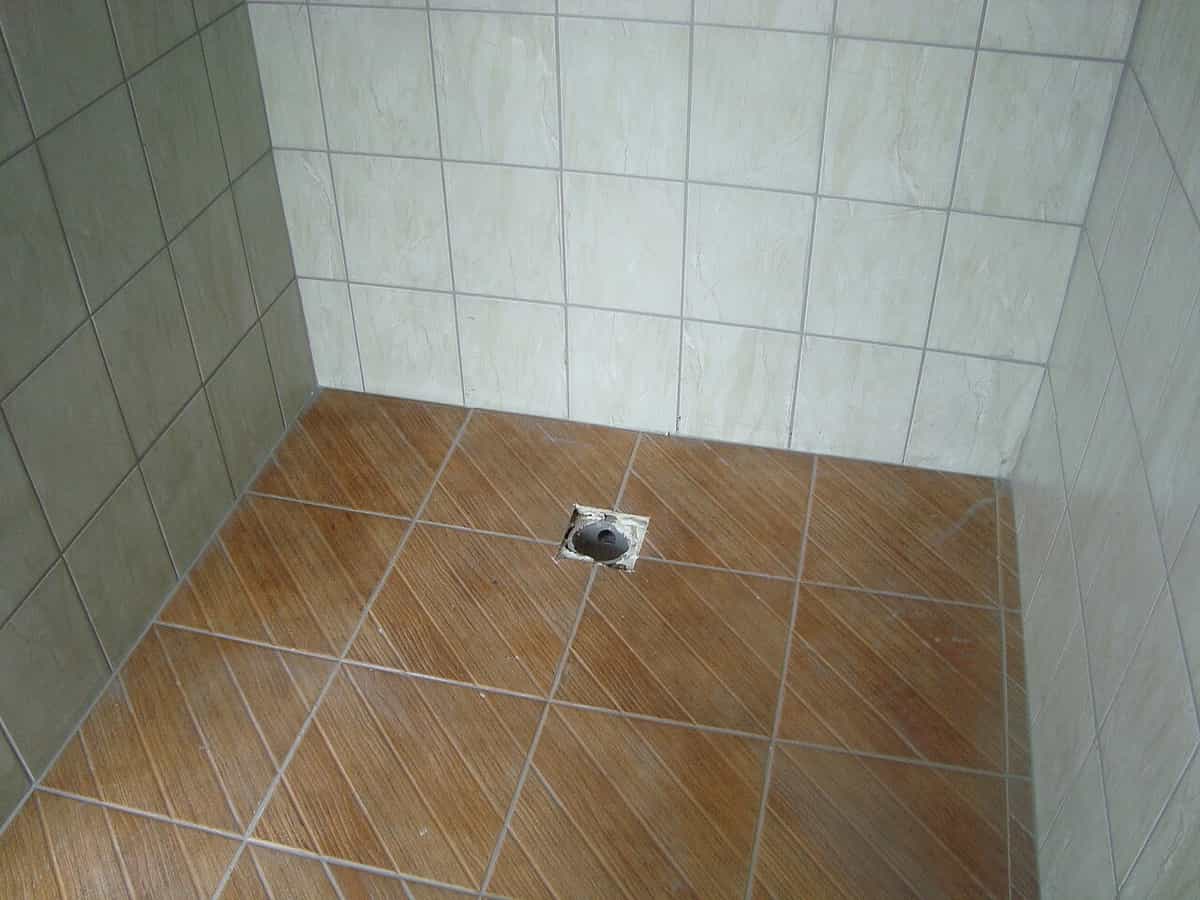
Step 1. Area to tile
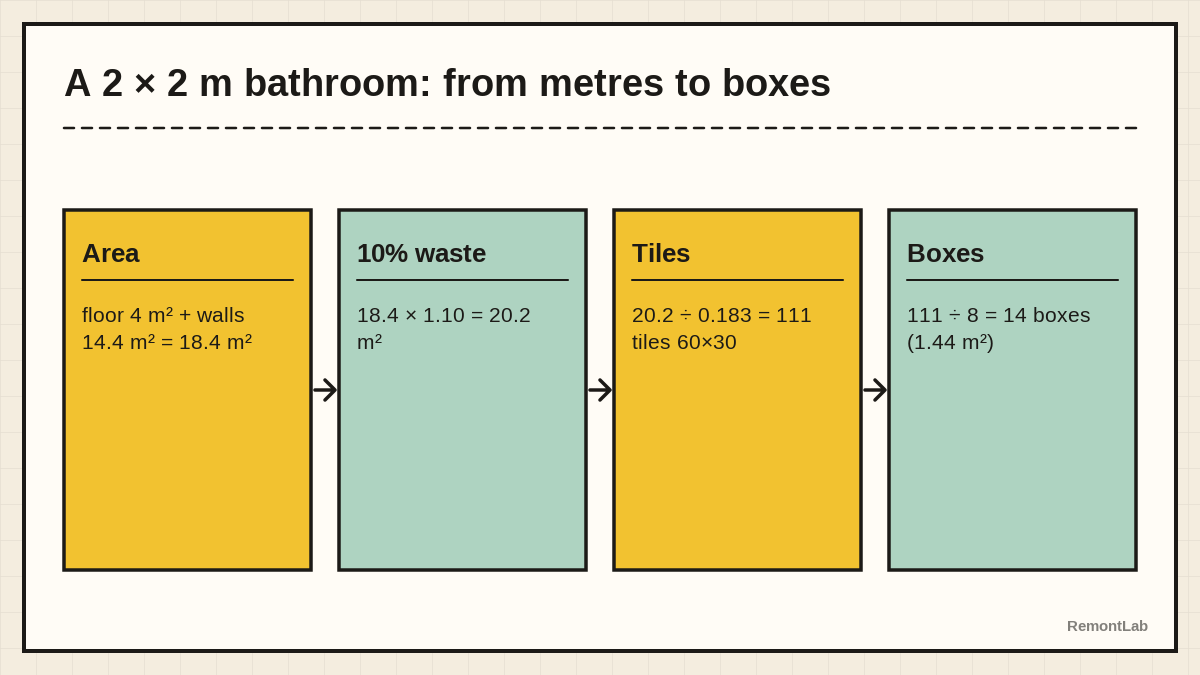
- Floor: 2 × 2 = 4 m²
- Walls: 8 m perimeter × 2 m = 16 m², minus the door (1.6 m²) = 14.4 m²
- Total: 18.4 m² – add niches, shelves and the WC frame casing if you have them.
Step 2. Add waste
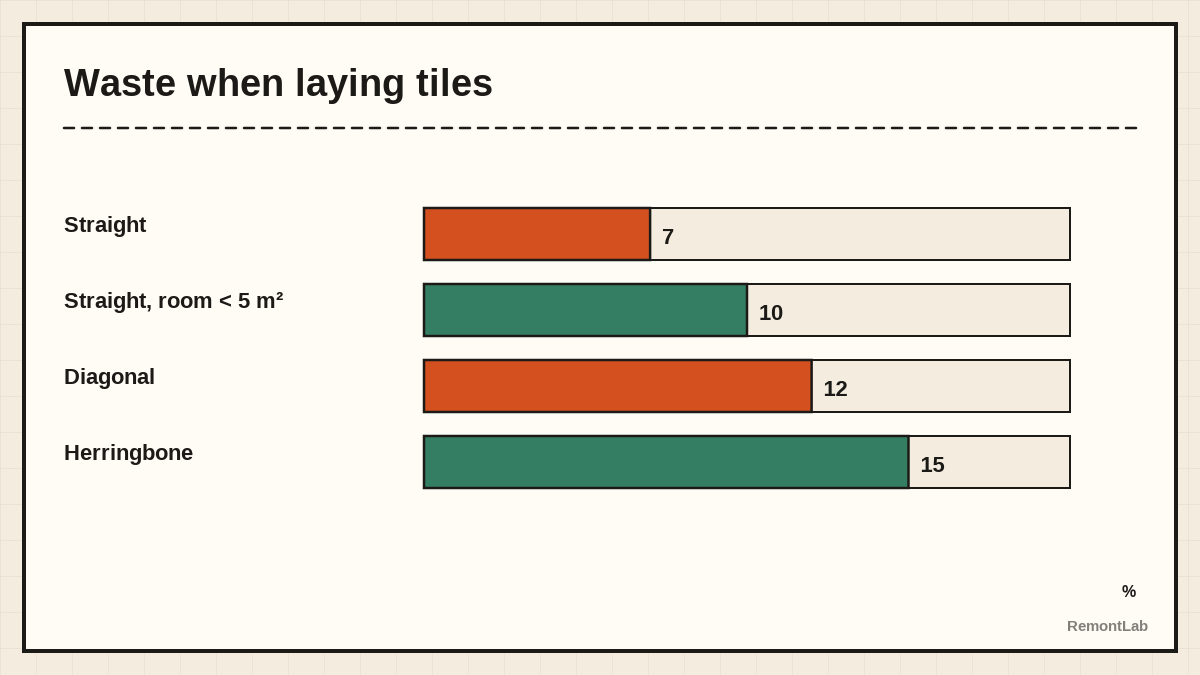
Allow about 7% for straight laying, 12% diagonal and 15% herringbone. For rooms under 5 m² add roughly 3 more points. Here 18.4 × 1.10 = 20.2 m².
Step 3. Convert to tiles and boxes
A 60 × 30 cm tile with a 3 mm joint covers about 0.183 m², so 20.2 ÷ 0.183 ≈ 111 tiles. With 8 tiles per box (1.44 m²) that is 14 boxes.
Step 4. Adhesive and grout
- Adhesive: an 8 mm notch uses about 3 kg/m². For tiles 60 cm and up, butter the tile as well (+25%). For 18.4 m² that is roughly 55–70 kg – three 25 kg bags.
- Grout: about 0.22 kg/m² for these tiles, so around 4–5 kg in total.
Enter your own sizes in the tile calculator for tiles, boxes, adhesive and grout.
Real examples: how other sites count
The cenauslug.pl tile calculator assumes about 7% waste for straight, 12% for diagonal and 15% for herringbone, with adhesive from about 1.8 to 4.2 kg/m² depending on the notch (+15% minor unevenness, +30% major, +25% back-buttering). budujemydom.pl's 5 m² bathroom example counts wall area as about 21.5 m² and advises 24 m² of wall tiles plus at least 5.5 m² of floor tiles.
How much reserve to add – three sets of advice
The reserve for cuts depends on the pattern and the area, and sources suggest slightly different figures. They are worth knowing, because the gap between “I'll buy one more pack” and “we ran out halfway” can be costly – kb.pl tells the story of someone who counted tiles almost to the square metre and was one pack short halfway through.
| Layout | Reserve per one guide | Reserve per another source |
|---|---|---|
| Straight | 10% (under 10 m²), 5% (10–50 m²), 3% (over 50 m²) | 5–10% |
| Diagonal | 15% (under 10 m²) | 10–15% |
| Herringbone and complex patterns | – | 15–20% |
A bathroom is usually under 10 m² with many cuts (bath, shower, WC, corners), so a practical rule is 10% for a straight layout and 15% for diagonal. For large-format tiles add a little more: one broken big tile is a bigger loss.
Example: a 2.0 × 2.4 m bathroom, 2.5 m high
- Floor: 2.0 × 2.4 = 4.8 m².
- Walls: perimeter 8.8 m × 2.5 m = 22 m², minus the door (1.6 m²) = 20.4 m² (tiles to the ceiling).
- Total: 25.2 m². Count floor and wall tiles separately – they are usually different ranges.
- 10% reserve: floor 5.3 m², walls 22.4 m².
- Packs: with 1.44 m² per pack the floor is 4 packs (5.76 m²) and the walls 16 packs (23.04 m²).
This is our own calculation – the number of packs depends on the format you choose. Always round up to whole packs and check whether the shop takes back unopened boxes.
Adhesive and grout
Adhesive use depends on the notch size and the evenness of the substrate. Roughly 5 kg/m² with a medium trowel for ceramic tiles; fixing onto an uneven substrate or old tiles needs a thicker bed and raises consumption by up to 30% (cenauslug.pl). For 25 m² that is about 125 kg, or 5–6 bags of 25 kg. Grout depends on tile size and joint width: for 30 × 30 cm tiles with 3 mm joints about 0.25–0.5 kg/m², and wider joints double it. A small bathroom usually needs 5–8 kg of grout.
Parameters people forget in the shop
- Abrasion class (PEI) – PEI 3–4 is usually enough for a bathroom floor; pick higher for a hallway or kitchen.
- Slip resistance – especially in the shower area; look for R10 or higher.
- Calibre and shade – tiles from different batches can differ in size and colour, so buy from one batch and add the reserve at once.
- Water absorption – low-absorption porcelain handles moisture and frost better.
The biggest mistakes
- Counting the area without a reserve for cuts.
- Buying “just enough” and later topping up from another batch.
- Forgetting trims, corner pieces and edge profiles.
- Counting a wall whole without subtracting the door and window – or subtracting openings that are too big.
- No layout plan – a pattern that needs matching uses more tiles.
Work it out more precisely in the tile calculator – it includes the layout pattern, adhesive, grout and spacers.
What other guides say about the reserve
| Site | What it says | Note |
|---|---|---|
| kb.pl | The story of someone one pack short even though the tiles were counted almost to the metre | A reserve for cuts is essential |
| muratordom.pl | A guide to calculating tile quantity; abrasion class and other parameters | The choice of tile affects the reserve |
| cenauslug.pl | A tile, adhesive and grout calculator; reserve 5–10% straight, 10–15% diagonal, 15–20% herringbone | Adhesive use depends on trowel and substrate |
Checklist before buying tiles
- Draw a plan of the bathroom and mark niches, shower and bath.
- Count floor and walls separately.
- Pick the layout and add the reserve.
- Check the slip-resistance class and water absorption.
- Buy from one batch (calibre, shade).
- Keep the receipt and packaging for a possible return.
Frequently asked questions
How much spare should I buy?
About 7% for straight laying, 12% diagonal and 15% herringbone, a few points more in small rooms.
What percentage reserve of tiles for a bathroom?
Usually 10% for a straight layout and 15% for diagonal; herringbone 15–20%. In a small bathroom with many cuts do not go below 10%.
How much adhesive for 25 m² of tiles?
About 5 kg/m², so about 125 kg (5–6 bags of 25 kg); up to 30% more on an uneven substrate.
Sources and real examples
The figures in this guide come from the pages below (accessed at publication). Prices change – check current quotes.
Redakcja RemontLab
The desk collects prices, checks formulas and cites every number.
Did you like this guide?
Get the next ones once a month.