Materials and quantities
How many rolls of wallpaper for a room? Counting with pattern repeat
A room with a 14 m perimeter and 2.6 m walls needs about 8 standard rolls. How pattern repeat works and how to avoid buying more later.
Redakcja RemontLab4 min read
On this page
Wallpaper is the one material you cannot count “from square metres”, though almost everyone starts that way. What counts is strips, the pattern and the fact that every piece is cut with a margin. One bad sum and you are two rolls short.

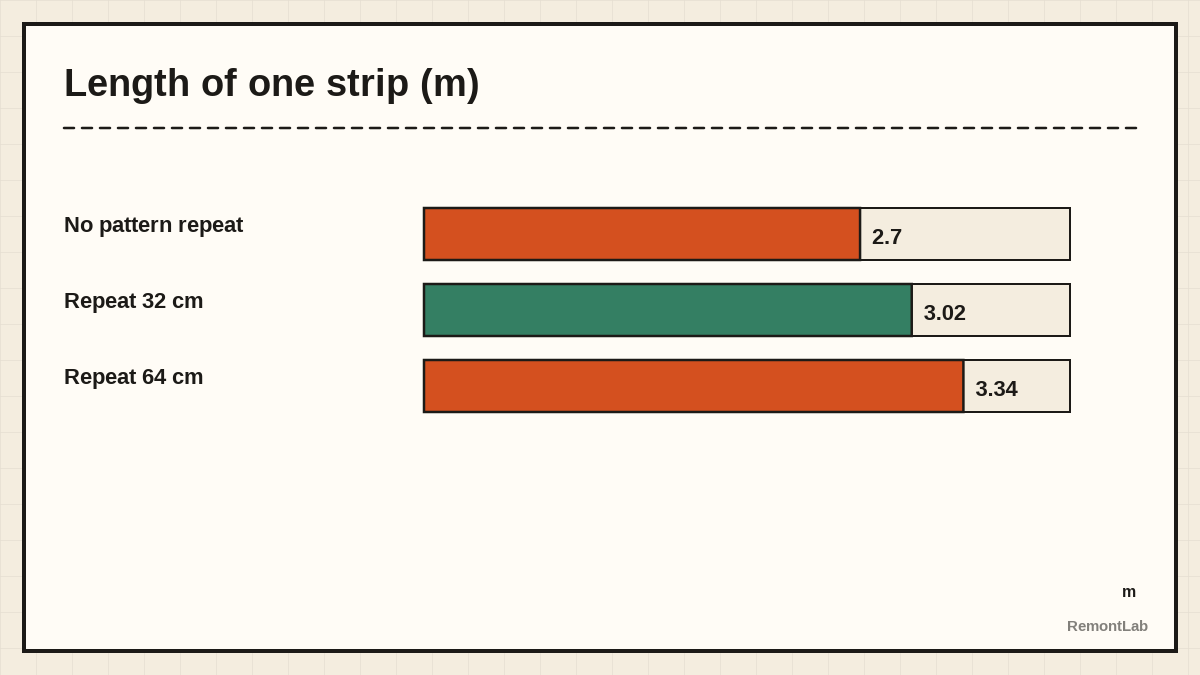
- Strip length = wall height + pattern repeat + about 10 cm. For 2.6 m walls: 2.7 m.
- Strips per roll = roll length ÷ strip length. A 10.05 m roll gives 3 strips.
- Strips needed = perimeter ÷ roll width: 14 ÷ 0.53 ≈ 26, about 24 after windows and doors.
- Rolls = 24 ÷ 3 = 8 rolls.
The wallpaper calculator handles roll sizes, pattern repeat and openings.
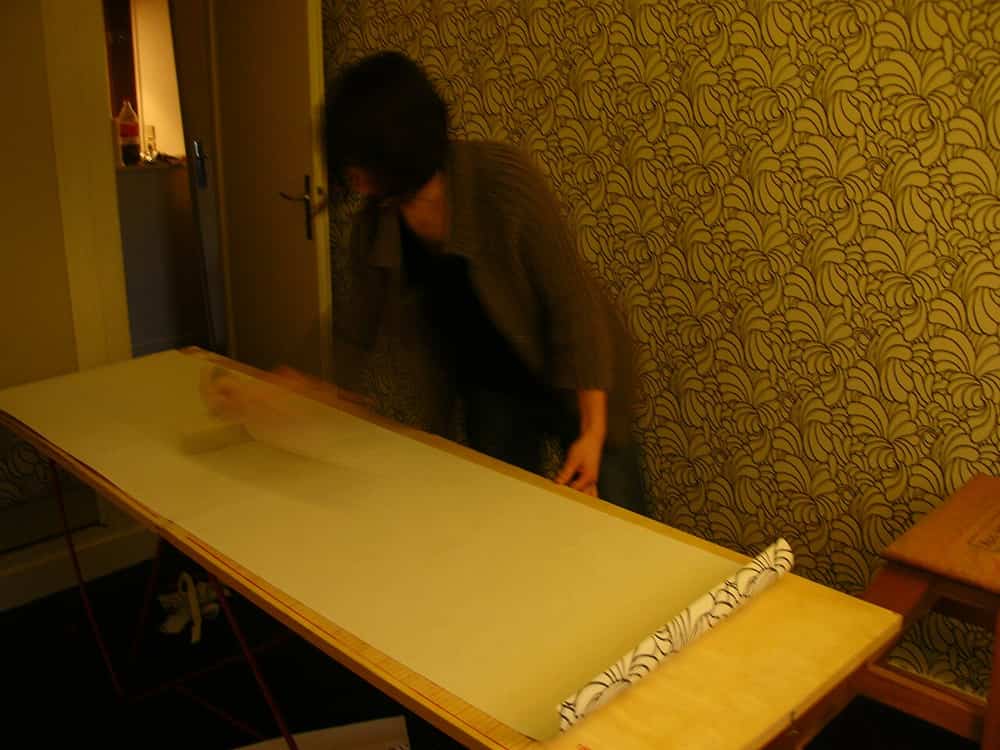
Why square metres are not enough
The commonest approach – wall area divided by roll area – almost always leaves you short. Polish guides, including cenauslug.pl's calculators, use the drop method: count how many strips you need, then how many strips one roll yields. The reason is simple: a strip has a fixed width (usually 53 or 106 cm) and a length equal to the wall height plus a margin, and the offcut at the end of a roll rarely fits another strip, especially when the pattern must be matched.
Pattern repeat – the key to the reserve
The repeat is the distance after which the pattern repeats. A plain or random-pattern wallpaper has little waste. A paper with a 32 cm or 64 cm repeat needs each strip shifted so the motifs line up, which uses extra material. The rule the sources repeat: cut each strip with about 10 cm extra (5 cm top and bottom), and with a large repeat even 45–60 cm. So geometric patterns and large florals need noticeably more rolls than a plain texture.
Example: a 4 × 3 m room, 2.6 m high, roll 0.53 × 10.05 m, repeat 32 cm
- Perimeter: 2 × (4 + 3) = 14 m. Subtract a door (0.9 m) and a window (1.5 m): 14 − 2.4 = 11.6 m to cover.
- Strips: 11.6 ÷ 0.53 = 21.9 → 22 strips.
- Strip length: 2.6 m + 10 cm trim + up to 32 cm for matching ≈ 3.0 m.
- Strips per roll: 10.05 ÷ 3.0 = 3.35 → 3 strips (the offcut does not count).
- Rolls: 22 ÷ 3 = 7.3 → 8 rolls. With a 10% reserve (four strips) – 9 rolls.
Our own calculation on sample sizes; check the roll size and repeat in the manufacturer's spec. For comparison, dividing areas (36 m² of wall ÷ 5.3 m² per roll) gives 7 rolls – so the m² method would have left you two rolls short.
Types of wallpaper
- Non-woven – paste goes on the wall, strips butt together; easy to strip dry.
- Paper – paste on the paper, wait for it to soak; cheaper but less durable (cenauslug.pl discusses when to choose it).
- Vinyl – washable and moisture-resistant, good for kitchens and hallways.
- Photo murals – bought as a set to fit the wall, not by the roll.
Wall preparation
Wallpaper shows every flaw, so the wall must be smooth, dry and primed. Remove flaking paint, fill, sand and prime. A smooth skim coat gives the best base (see our skim coat guide). On a dark wall, thin light wallpaper can show through – prime in white first.
Practical tips
- Buy all rolls from one batch (batch number on the label) – colour from another batch can differ.
- Keep one roll for future repairs.
- Start where the join will be least visible; the last strip usually ends untidy.
- Switch off power and tape over sockets before papering a wall with sockets.
Work out the rolls for your room with the wallpaper calculator – it includes the repeat and the wall height.
How others count wallpaper
| Site | What it says | Note |
|---|---|---|
| cenauslug.pl | The drop method: count strips, not m²; pattern shift creates material losses | Dividing areas usually gives too little |
| European guides (for example Bora Tapeter, MeineWand) | Strip length = wall height + pattern repeat + about 5 cm for trimming | An example with a 7.65 m wall and a 0.53 m roll: 14.43 strips → 15 |
| General calculators | 10–15% reserve and a 45–60+ cm allowance for a large repeat | A lot depends on the pattern |
Checklist before papering
- Measure the perimeter and height, subtract doors and windows.
- Check roll width and length and the repeat.
- Count strips, not metres.
- Add a 10–15% reserve.
- Prime the wall and remove socket covers.
- Keep one roll for repairs.
Frequently asked questions
What is a pattern repeat?
The distance after which the pattern repeats; matching it needs longer strips.
Can I calculate wallpaper from square metres?
It is imprecise and usually leaves you short. Count strips (drops) with the pattern repeat and a trim allowance.
How much spare wallpaper should I buy?
At least 10–15% – for cutting mistakes, pattern matching and future repairs.
Sources and real examples
The figures in this guide come from the pages below (accessed at publication). Prices change – check current quotes.
Redakcja RemontLab
The desk collects prices, checks formulas and cites every number.
Did you like this guide?
Get the next ones once a month.